IAMPRASADTECH • 2026 BUYER’S GUIDE

How to Choose the Right Smartphone in India 2026

Not a spec sheet. Not marketing copy. Just an honest breakdown of what actually matters when you’re standing in a phone store in India and can’t decide.

🇮🇳 India Focused
☕ No Fluff
✅ Updated March 2026

Someone asked me last week, “Bhai, I have ₹30,000 to spend. Which phone should I get?” I asked back — “What do you use your phone for the most?” Silence. They hadn’t thought about that.

That’s the real problem when buying a smartphone in India in 2026. There are 400+ models available across every price range. Every brand claims its phone is the best. Every spec sheet looks impressive. And most people end up buying a phone based on a YouTube ad they saw, or what their friend bought, or whatever was on sale during the last Big Billion Day.

This guide cuts through all of that. I’ll tell you exactly what to look for, what to ignore, and what questions to ask yourself before spending ₹15,000 to ₹1,50,000 on your next phone.
Step 1 — Figure Out Your Budget First

And be honest with yourself about it.

Before you look at a single spec, decide how much you’re actually willing to spend. Not “how much would be ideal” — how much will you realistically pay without stressing about it next month? That number matters more than anything else in this guide.

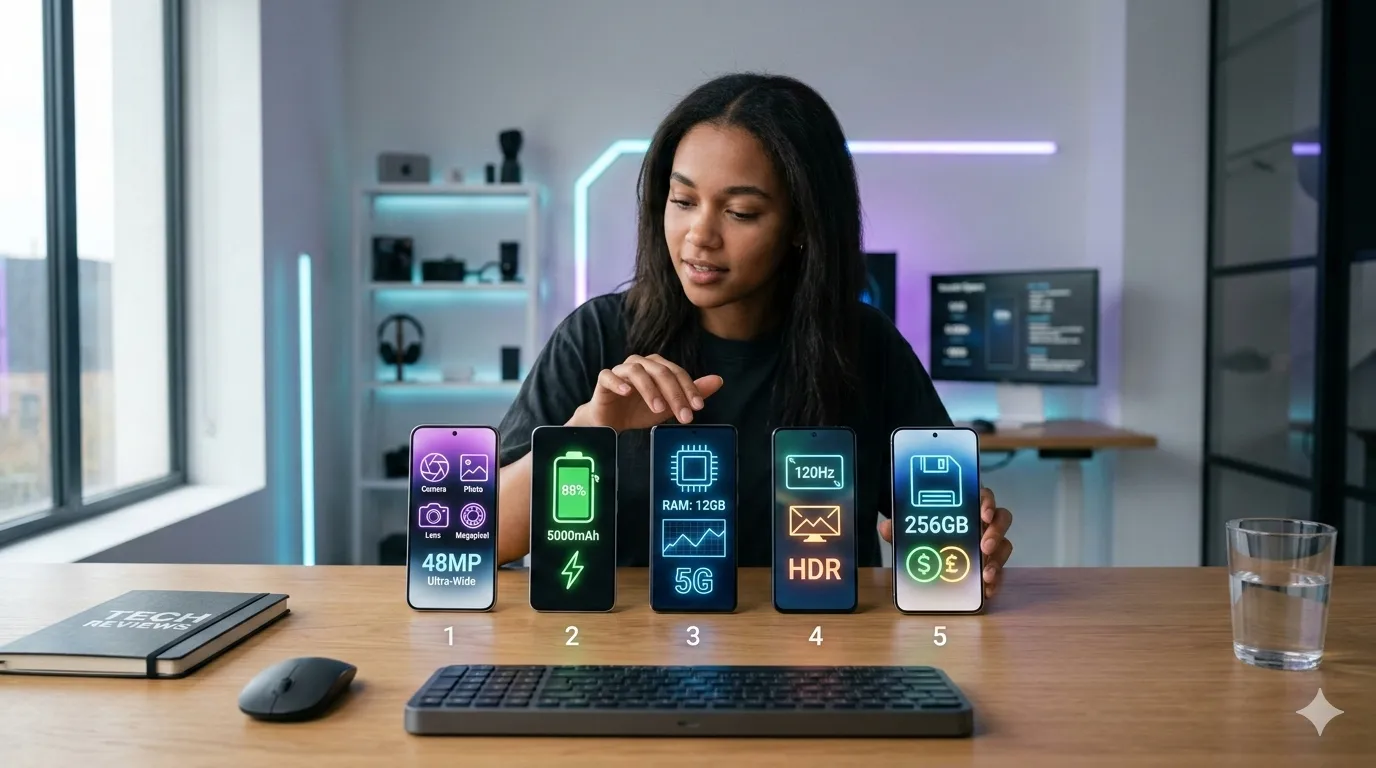
The Indian smartphone market in 2026 is genuinely good at every price point. Here’s how to think about each range:

Under ₹15,000 — Budget phones

For calls, WhatsApp, YouTube, and social media. Realme, Redmi, Poco, and Samsung Galaxy A-series dominate here. You won’t get a great camera or top-tier performance, but daily life tasks work absolutely fine.

Best for: Parents, first phone buyers, people who don’t need anything fancy.

₹15,000 to ₹35,000 — Mid-range

This is where the real value is in India. 120Hz AMOLED displays, 50MP cameras, 5000mAh batteries, 5G — all available at this price. Phones like Redmi Note 14 Pro, Realme 13 Pro, and Samsung Galaxy A55. You’re getting 80% of the flagship experience for 25% of the flagship price.

Best for: Students, young professionals, anyone who wants a good all-around phone without overspending.

₹35,000 to ₹70,000 — Upper mid-range

This is the sweet spot for many Indian professionals. Phones like OnePlus 13, iQOO 13, Samsung Galaxy S24 FE — proper flagship processors, excellent cameras, fast Charging. You’re paying for noticeably better performance and build quality.

Best for: Working professionals, content creators, and heavy users who spend long hours on their phone.

Above ₹70,000 — Flagship territory

Samsung S25 Ultra, iPhone 16 Pro Max, Google Pixel 9 Pro. The best cameras money can buy, top processors, and long software support. The performance jump from mid-range to flagship exists, but it’s smaller than the price difference suggests. You’re paying a premium for the best, not just for good.

Best for: Professionals who rely heavily on their phones, photography enthusiasts, and people who keep their phones for 5+ years.

💡 Quick reality check — A ₹25,000 phone from 2026 handles WhatsApp, Reels, BGMI, and daily calls perfectly. If someone is telling you that you “need” to spend more than that for everyday use, they’re either misinformed or trying to upsell you.

Step 2 — Android or iPhone?

Settle this first before looking at anything else.

Android vs iPhone which to choose India 2026

This is the most debated question in tech. My take after 8 years of using both? Pick based on your life situation, not brand loyalty.

Android 🤖

  • Available from ₹7,000 to ₹1.5 lakh+
  • Fully customisable — change launchers, icon packs, default apps
  • Better file management — plug into the PC and transfer freely
  • Sideloading apps is possible
  • Many brands to choose from — Samsung, OnePlus, Xiaomi, Vivo, OPPO, Realme
  • Works great even if you don’t own any other Apple device

iPhone 🍎

  • Starts at ₹55,000 (iPhone 15), goes up to ₹1.6 lakh+
  • Fastest chip on any phone — A18 Pro in the latest models
  • Exceptional if you also use a MacBook, iPad, or Apple Watch
  • Best resale value — 2-year-old iPhones sell for 50%+ of original price
  • iOS is very simple and secure — great for non-tech-savvy users
  • 5+ years of software updates guaranteed

My honest advice — If you already use a MacBook or iPad, get an iPhone. The ecosystem integration is genuinely useful and not something Android replicates well. If you don’t own any Apple products, Android gives you more flexibility at every price point. Don’t pay a premium for the Apple brand if you’re not going to use the ecosystem.

Step 3 — The Processor (Chip)

The engine under the hood — here’s what actually matters

People overthink this. Let me simplify it. The processor is the brain of your phone. A fast processor means apps open quickly, games run smoothly, the camera processes photos faster, and the phone stays responsive even after 2 years of use. A slow processor means lag, heating, and frustration.

In 2026 in India, here are the chips that actually matter and what they mean for real use:

ProcessorTierGood For
Snapdragon 8 Elite / 8 Gen 3FlagshipHeavy gaming, 4K video editing, 5+ years of use
Snapdragon 7s Gen 3 / Dimensity 9300Upper MidDaily use, casual gaming, and good cameras
Snapdragon 6 Gen 1 / Dimensity 7300Mid-RangeWhatsApp, YouTube, social apps, light gaming
Apple A18 Pro / A18FlagshipBest chip on any phone — iPhones only
Google Tensor G4Upper MidAI tasks, camera processing — Pixel phones only

Real talk — If you’re not gaming heavily or editing videos, a mid-range Snapdragon or Dimensity chip handles everything in daily Indian life perfectly. Don’t let a salesperson talk you into a flagship chip “just in case.” You probably don’t need it.

Step 4 — RAM and Storage

The mistake 70% of Indian buyers make

How to choose RAM and storage smartphone India 2026

I see this happen constantly in phone stores — people buy 64GB of Storage to save ₹2,000, and then spend the next 18 months deleting photos to free up space. Don’t do this to yourself.

On RAM — this determines how many apps your phone can keep running in the background without reloading. Open WhatsApp, switch to Chrome, then go back to WhatsApp — if your chat reloads, your phone is low on RAM.

6GB RAM

Manageable for basic use, but apps reload frequently if you switch between many at once. Okay for parents or light users. Don’t go below this.

8GB RAM

The sweet spot for most people is in 2026. Handles multitasking well, keeps apps in memory, and runs games without issues. This is what most people should aim for.

12GB+ RAM

For heavy gamers, people who run many apps simultaneously, and anyone who plans to keep the phone for 4-5 years. Future-proofs you well.

On Storage — this is where the real Indian buyer mistake happens. People underestimate how much space photos, videos, WhatsApp media, and apps take up.

What takes up space on an average Indian phone:

  • WhatsApp media (photos/videos from groups) — easily 5GB–15GB after a year
  • 3-4 large games like BGMI, Free Fire — 3GB–8GB each
  • Camera photos and videos — 1GB per 100 photos roughly
  • Streaming apps like Netflix, YouTube, downloaded content — 2GB–10GB
  • Regular apps — 50MB–500MB each

Bottom line on Storage — Get at least 128GB in 2026. Honestly, go for 256GB if you can afford it. The extra ₹1,500–₹3,000 to jump from 128GB to 256GB is worth every rupee three years from now, when your phone is still running smoothly instead of throwing “Storage Full” alerts at 7 am.

Step 5 — The Display

You look at this for 4+ hours a day. Don’t cheap out on it.

Screens matter more than most people realise — because you’re staring at it constantly. Long commutes on the Mumbai local, scrolling Reels in bed, watching IPL on a long train journey from Hyderabad to Bangalore. A good screen makes all of this noticeably better.

AMOLED vs LCD — this is the one that matters most. AMOLED displays have deeper blacks, punchier colours, and use less battery in dark mode. LCD screens look washed out in comparison once you’ve seen a good AMOLED. In 2026, even phones at ₹15,000 are starting to offer AMOLED — there’s very little reason to accept an LCD screen.

Refresh Rate — what it actually means

60Hz — Standard. Fine for calls and basic apps, but scrolling looks slightly choppy. Acceptable at ₹10k, not acceptable at ₹25k+.

90Hz — Noticeable improvement. Scrolling feels smoother, and gaming is better.

120Hz — This is what you want. Everything feels buttery smooth. Once you’ve used 120Hz, going back to 60Hz feels like watching a video that’s buffering.

Screen Size — your life, your call

Under 6.1″ — Easy to use one-handed. Getting rare in 2026. iPhone 16 is the main option.

6.1″ to 6.5″ — Most comfortable size. Good balance of usability and screen space.

6.5″ to 6.9″ — Great for media. A bit large for one-handed use. Popular for gaming and video.

What to ask in the store — “Is this an AMOLED display?” and “What is the refresh rate?” If the salesperson can’t answer these two questions confidently, walk to someone else.

Step 6 — Camera: Ignore the Megapixels

Seriously. Stop looking at megapixel counts.

Every phone in 2026 has a “64MP camera”, “108MP camera”, or even “200MP camera.” And people think more megapixels = better photos. That’s not how it works.

A 12MP iPhone takes better photos than a 64MP phone from a budget brand. Because camera quality depends on sensor size, lens quality, image processing software, and AI algorithms — not on the megapixel count the brand printed on the box.

Here’s what actually matters when evaluating a camera:

Night Mode — test this before buying

India has a lot of low-light situations — marriage halls, street food stalls at night, family gatherings indoors, and cricket on evenings. A camera that handles low light well is 10x more useful in real Indian life than one that only takes great photos in sunlight.

OIS — Optical Image Stabilisation

This physically stabilises the camera sensor when your hand shakes. Videos come out smooth, photos come out sharp. Very important if you shoot videos while walking or travelling. Check the specs for “OIS” — some budget phones only have EIS (digital stabilisation), which is inferior.

Zoom — optical vs digital

Optical zoom uses a real secondary lens. Digital zoom just crops and enlarges the photo — basically just making the image bigger and blurrier. “3x optical zoom” is genuinely useful. “3x digital zoom” is just marketing. Look for “optical” in the zoom specs.

Front camera — if selfies matter to you

Many people in India use the front camera heavily — for selfies, Reels, video calls on WhatsApp and Google Meet. A 16MP+ front camera with good skin-tone processing is worth checking, specifically if this is important to you.

Best cameras in India right now by budget — Under ₹20k: Realme 13 Pro. Under ₹35k: Redmi Note 14 Pro+. Under ₹60k: iQOO 13. Flagship: Google Pixel 9 Pro for AI, Samsung S25 Ultra for raw detail.

Step 7 — Battery Life

Especially important in India — here’s the honest breakdown

Battery life matters more in India than in most other countries. Why? Power cuts in smaller cities and towns. Long commutes where you can’t charge. 42°C summers in Rajasthan and Telangana, where batteries drain 20–30% faster because heat reduces battery efficiency. Extended outdoor hours without access to charging.

Here’s the honest battery guide for Indian buyers:

Below 4500mAh

It might not last a full day for heavy users. Acceptable only in premium phones like iPhones, where the software-hardware optimisation compensates. In Android phones at ₹20k–₹50k — avoid.

4500–5000mAh

One full day comfortably for most users. Fine for average use — calls, social media, some video. Standard in 2026 at most price points.

5000mAh+

Full day for heavy users. Easily 1.5 days for moderate users. Get this if you travel, spend time outdoors, or can’t always charge at the end of the day.

6000mAh+

2 full days for most people. Best for students, outdoor workers, and people in areas with unreliable power supply. Realme 15T (7000mAh at ₹19,999) is extraordinary at this.

Fast Charging — don’t ignore this

In 2026, fast charging speeds range from 25W (embarrassingly slow, looking at you, Apple) to 120W (Xiaomi, fills up in 25 minutes). For Indian buyers who plug in and leave for work in 30 minutes, charging speed genuinely affects daily life. Look for at least 65W on any Android phone above ₹25,000. 30W is acceptable at lower budgets.

Step 8 — Software Updates

The most ignored factor. It decides how long your phone stays useful.

Most people in India change phones every 2–3 years. But a phone that gets software updates stays faster, safer, and compatible with new apps longer. A phone without updates becomes a security risk and starts showing “app not compatible” errors within 2 years.

Here’s how the major brands compare on update commitments in 2026:

BrandOS UpdatesSecurity Patches
Samsung (flagship)7 years7 years
Google Pixel7 years7 years
Apple iPhone5–6 years5–6 years
OnePlus4 years5 years
Xiaomi / Redmi3–4 years4 years
Realme / Vivo / OPPO2–3 years3–4 years

If you plan to use a phone for 3+ years, pick a Samsung flagship, Google Pixel, or iPhone. Their update commitments are the best in the industry, and it genuinely matters when you’re still using the same phone in 2029.

Step 9 — Extra Features Worth Paying For

And the ones that aren’t worth a single rupee extra

Every phone box in 2026 has a long list of features. Not all of them are useful in real Indian life. Here’s my honest split:

Worth paying extra for ✅

5G — Jio and Airtel 5G now cover most Indian cities. If you’re buying a phone today, get 5G. You’ll use it for the next 3–4 years.

IP67 or IP68 water resistance — Protecting your phone from rain, sweat, accidental spills, and that moment your phone falls into a bucket of water. Getting common even in mid-range phones now.

In-display or side fingerprint sensor — Unlocking your phone quickly matters 200+ times a day. Make sure the sensor is fast and accurate. Test it in the store.

Stereo speakers — If you watch a lot of videos or listen to music on your phone without headphones, stereo speakers make a real difference. Mono speakers sound thin and hollow in comparison.

Don’t get fooled by these ❌

High megapixel front cameras marketed as “selfie phones” — As explained earlier, megapixels ≠ quality. A 16MP camera with good processing beats a 32MP camera with bad processing. Test the actual sample photos, not the number.

Multiple cameras without useful zoom — Some phones have 3 cameras, but two of them are a 2MP “depth sensor” and a 2MP “macro” that you’ll use twice in your entire ownership. Really useful cameras have wide, ultrawide, and optical zoom. Check what each lens actually does.

Curved displays — Pretty, yes. Practical? Not really. They make screen protectors harder to apply, cause accidental touches at the edges, and cost more to repair when they crack. Flat displays are cheaper to repair and just as good to look at.

🎯 Who Should Buy What — Quick Guide

Student with ₹15,000–₹25,000 budget

Battery life is your priority — you’re away from chargers all day. Look for a 5000mAh+ battery, 128GB storage, 8GB RAM, and an AMOLED display. Realme, Redmi, and Poco give the most specs for the money in this range. Don’t bother with flagship brands here — waste of money.

Working professional with ₹30,000–₹60,000 budget

You need reliability and longevity. Pick a phone from Samsung (A-series or S-series FE), OnePlus, or iQOO. Good camera for work meetings and travel, clean software, fast Charging, so you’re not hunting for a charger between client meetings in Bengaluru’s traffic.

Mobile gamer

Snapdragon 8-series chip is non-negotiable. 12GB RAM. 120Hz+ AMOLED display. At least 5000 mAh battery — gaming drains quickly. Look at ASUS ROG Phone, iQOO series, or Poco F-series for gaming-specific features at competitive prices.

Photography or content creator

Don’t just look at specs — look at camera samples from real Indian reviewers. Google Pixel 9 Pro for AI features, Vivo X200 Pro for video stabilisation, Samsung S25 Ultra for overall camera quality. OIS is non-negotiable if you shoot video.

Parent buying for elderly family member.

Simple interface, large display, loud speakers, good call quality, and long battery life. iPhone with iOS is easy for seniors who aren’t tech-savvy — very simple to use. Android alternative: Samsung Galaxy A-series has an “Easy Mode” with large icons. Don’t buy anything with MIUI ads for elderly parents — it confuses them.

Bottom Line

Choosing a smartphone isn’t complicated once you know what you actually need. Figure out your budget. Decide on Android or iPhone. Make sure the RAM and Storage are adequate for 3 years of use, not just today. Check the battery size and fast-charging speed. Look at camera samples in real conditions, not studio shots. And verify how long the manufacturer promises software updates.

Do all that, and you won’t regret your purchase. It’s really that straightforward.

Drop your budget and your main use case in the comments below — I reply to every single one, and I’ll tell you exactly which phone to get. 👇

📅 Updated March 2026
✍️ IamPrasadTech
🇮🇳 India Buyers

Looking for specific phone recommendations?

Check out my detailed roundups for every budget:

👉 Top 10 Mobile Phones in India 2026

LEAVE A REPLY

Please enter your comment!
Please enter your name here